A brief history of the Pike-Fletcher-Terry Mansion in Little Rock, AR
The Pike-Fletcher-Terry Mansion
c. 1840
The Pike-Fletcher-Terry House has been widely recognized as an architectural landmark since its construction in 1840. It has housed several prominent Arkansas families and served as a school and museum. The house hosted the Women’s Emergency Committee to Open Our Schools (WEC) during the aftermath of the desegregation of Little Rock Central High School in 1957. Although the house was remodeled several times, it retains much of its original Greek Revival character. The Pike-Fletcher-Terry House was listed on the National Register of Historic Places on August 21, 1972.
The builder of the house, Albert Pike, came to Arkansas from New England in 1832 and had a varied career that included being a teacher, poet, lawyer, newspaper owner and editor, and Civil War general. In 1839, he purchased the twelve lots of block 61 from Chester Ashley, a prominent lawyer and land speculator who later became a U.S. senator. Pike purchased an additional lot across 8th Street to the south, where he constructed additional outbuildings. For both purchases, he used resources either from the estate of his wife’s father or from his new career in law. The house in its original configuration was two-story brick, with a central hallway on each floor, two large rooms on each side, and a low, sloping hipped roof used to collect and channel rainwater to one or more cisterns. Pike constructed a number of outbuildings—including a two-story detached kitchen, a stable, and a carriage house. The initial configuration of the house had a small front porch of unknown design. Within the next few years, this porch was removed and replaced with a broad gallery with six monumental Ionic columns.
In August 1873, the board of directors of Arkansas Female College leased the house and grounds from Lillian Pike, Albert Pike’s daughter, to whom he deeded his interest in the property in 1871. The school opened its doors in early October 1874. When Pike’s wife, Mary Ann, died in 1876, his daughter became the sole owner of the house. The buildings were soon expanded, the new construction being described in the Second Annual Catalogue of the Arkansas Female College for the collegiate year ending on June 7, 1876, as a “two-story addition eighty feet long by thirty-five feet wide, containing a large study hall, recitation room, and dormitories.”
The school continued in operation on the property under the direction of a veteran teacher, Myra C. Warner, as principal. Lou Krause purchased the property in March 1886 and planned ambitious improvements for the school, but they were never made. In 1889, she transferred title of the property to her brother-in-law, John G. Fletcher, and moved the college to smaller quarters.
In 1889, the property ownership was transferred to John G. Fletcher and his wife, Adolphine Krause Fletcher. The couple had three children and made numerous changes to the property. Fletcher and his wife, Adolphine Krause Fletcher, continued the high-profile occupancy of the house. He was a native Arkansan and Civil War veteran who, in the years following the war, became a prominent banker and one of the South’s leading cotton brokers, in partnership with Austrian-born merchant and broker Peter Hotze. The partnership lasted until their retirement in 1900. Fletcher was president of the German National Bank and a civic leader of his day. He was also Little Rock’s mayor from 1875 to 1881 and an unsuccessful Democratic candidate for governor in 1884 and 1888.The classroom building from the Female College was removed, as was the original two-story kitchen building, which was replaced with an indoor kitchen. A conservatory was added on the east side and a porch on the west side, and the low roof was replaced with a much steeper one.
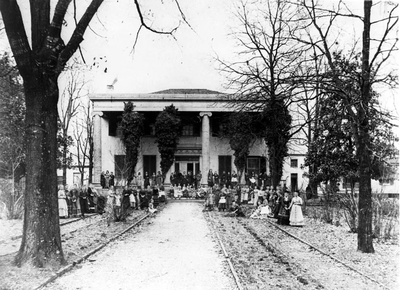
Photos of the Arkansas Female College courtesy of Arkansas State Archives
Possibly the most well known resident of the Pike-Fletcher-Terry Mansion, Adolphine Fletcher Terry, took ownership in 1910 after her mother passed away. The property was willed to Adolphine and her two siblings. Adolphine married David Dickson Terry, who distinguished himself as a lawyer, civic leader, and U.S. congressman (1933–1942). They were married in the front parlor of the house in 1910, and they lived in the house for most of the rest of their lives, except for parts of the years 1933 to 1942, which they spent in Washington DC while David Terry served in Congress. Even then, Adolphine Terry was in Little Rock most of the time with their five children.
Adolphine Fletcher Terry spent much of her life working for the causes of educational improvement, public libraries, and racial harmony. She was well known as the leader of the WEC, and many of the meetings were held in her house, a fact that is commemorated by the etched names of the committee members in the glass panels of the conservatory.
Adolphine would go on to chair the very first QQA Tour of Homes in 1963.
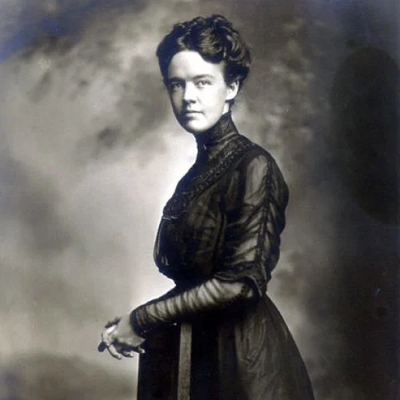
Photo of Adolphine Fletcher Terry from the Fletcher-Terry Family Papers, 1826-1976 (UALR.MS.0018), courtesy of the University of Arkansas at Little Rock Center for Arkansas History and Culture.
In 1916, the old stables and servants quarters were removed, a brick garage was built, a sleeping porch was added over the west porch, and a screened porch was constructed to the rear. The main staircase was replaced by the present in the Colonial Revival style.
Deeded to the city of Little Rock in 1964, the house was used as a museum and opened as the Arkansas Arts Center Decorative Arts Museum in March 1985. In 2004, it became the Arkansas Arts Center Terry House Community Gallery, a multi-purpose gallery in which local and regional art was shown.
Within a few years, the house had been vacated and left to sit empty until it was added to Preserve Arkansas’s “Most Endangered” list in 2021. Shortly after, heirs of Adolphine Fletcher Terry and Mary Fletcher Drennan filed suit against the City of Little Rock, the Arkansas Museum of Fine Arts, and the museum’s foundation, alleging that, by allowing the property to fall into disrepair, the city and museum have violated the terms by which the property was conveyed, and thus the house should be returned to the family. After years in the courts, the Fletcher heirs were awarded the return of the property and a portion of the original endowment.
15 heirs of the family were awarded ownership of the house. After the development of a non-profit to care for the house, and a mission to use the house in a public manner, the family and heirs have decided to sell the property. Their hope is that “someone who loves the house and grounds and appreciates the significant Arkansas history associated with the people connected to the house will see the benefit of preserving the property.”
The QQA is dedicated to preserving this 1840 built home and the history that accompanies it.
Historical overview of the Pike-Fletcher-Terry mansion courtesy of the Encyclopedia of Arkansas and originally written by Charles Witsell Jr.